What type of mobile selling system is shown on this product page?
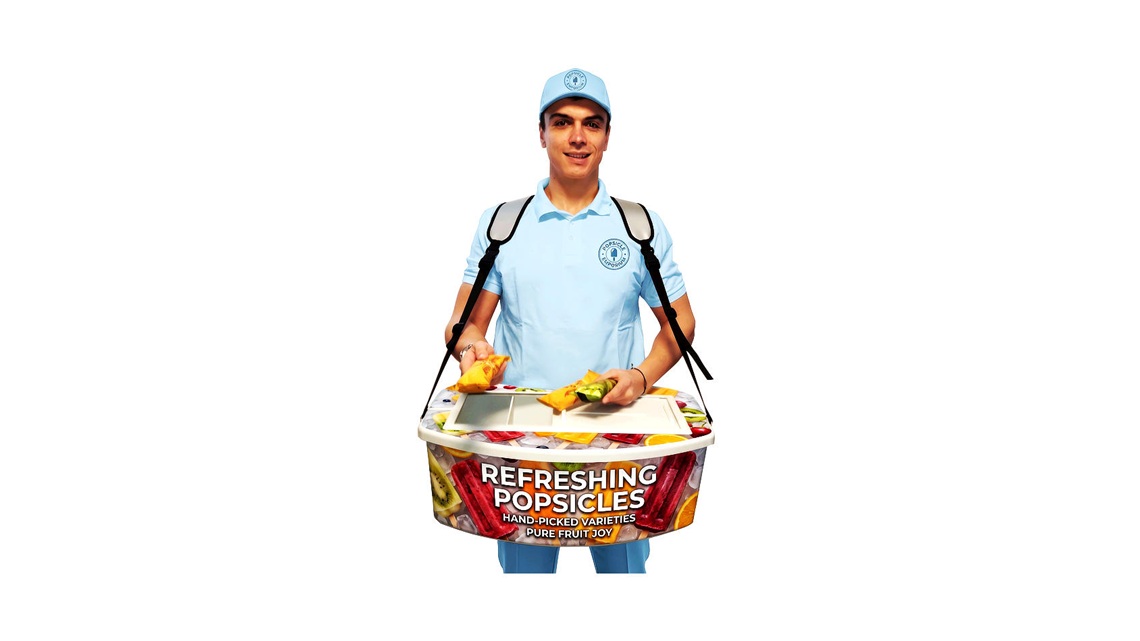
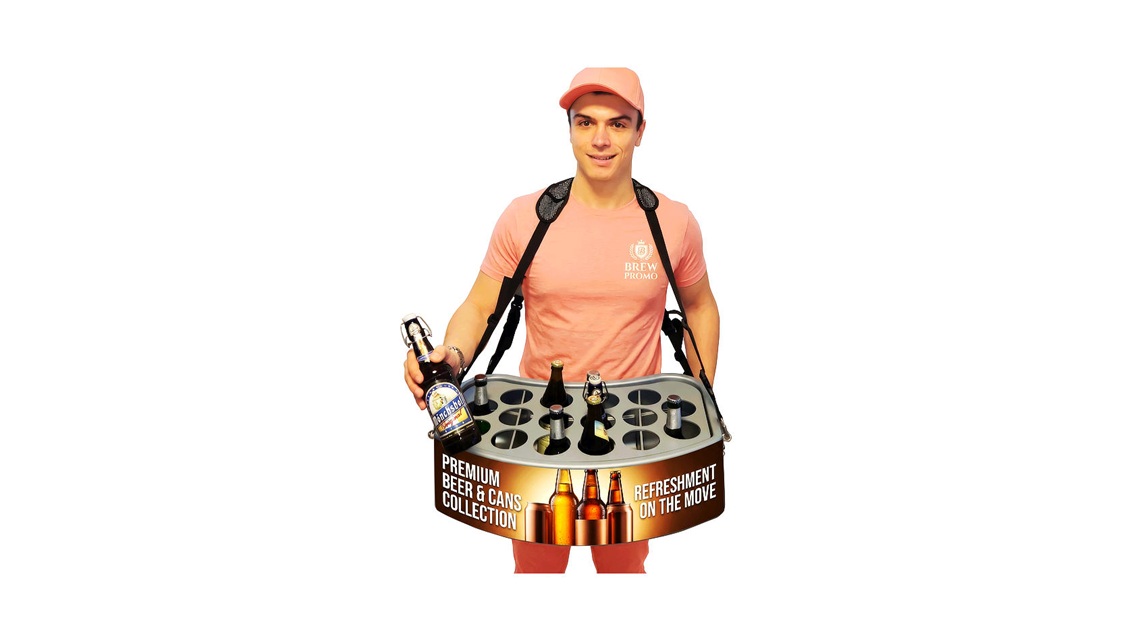
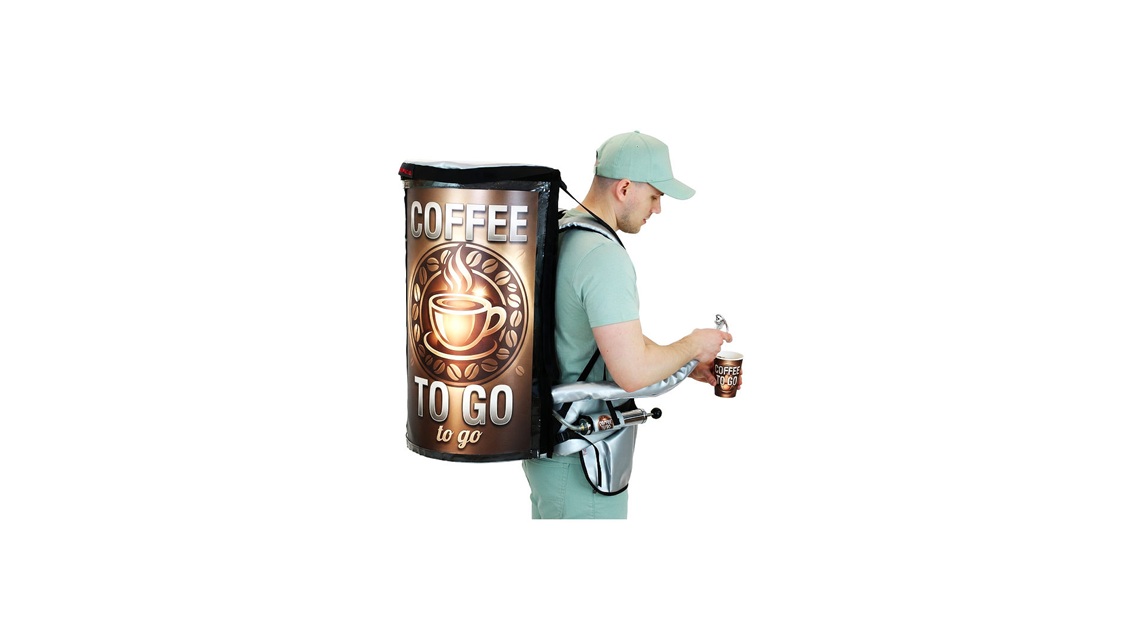
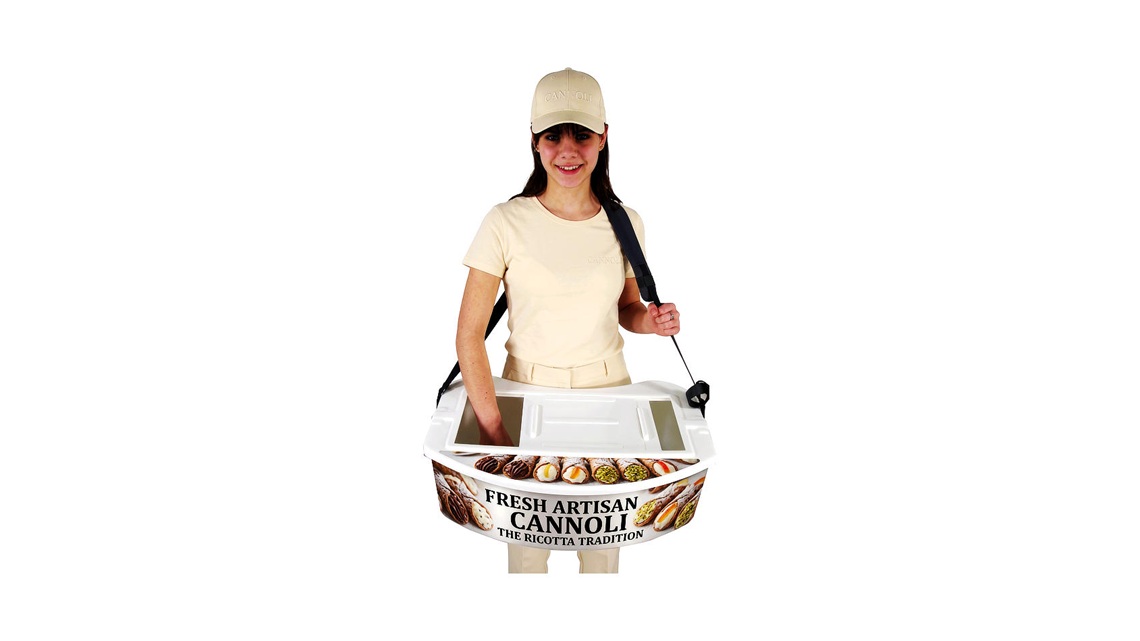
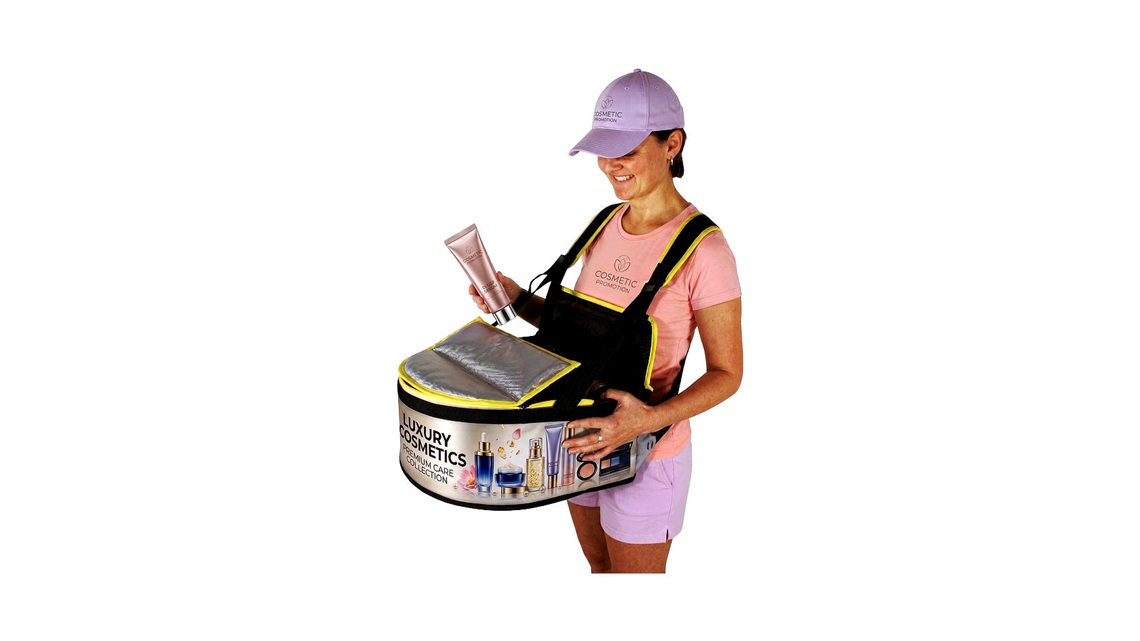
The page presents a rigid front-carried vending tray for packaged drinks, snacks and promotional goods. Its fixed shell, adjustable carrying system and configurable interior are intended for repeated mobile service at events, stadiums, retail locations and outdoor campaigns.
The tray is a manual selling and transport system. It does not dispense products automatically and does not replace the operator, stock point or payment process.
Which components are repeatedly listed as the standard working configuration?
The page repeatedly refers to a plastic tray, a four-point harness, a 16-hole insert and a set of three partition walls. It also shows a front advertising solution that can be prepared with a foil pocket or stickers.
The exact quotation should state which of these items are included. Images may show accessories, payment devices or campaign elements that are not automatically part of every delivery.
Why do some technical figures on the page differ from one another?
The page contains several reference descriptions and campaign examples. It lists approximately 20 litres and 2.5 kilograms for one passage, while another reference states 28 litres and 2.3 kilograms including inserts.
These figures should not be combined into a single assumed specification. The current model, supplied inserts and confirmed quotation must identify the applicable capacity and empty weight.
Which outside and inside dimensions are stated for the tray?
One technical section lists outside dimensions of approximately 60 centimetres long, 18 centimetres high and 33 centimetres deep. The corresponding inside dimensions are stated as approximately 55.5 by 17.5 by 29 centimetres.
These measurements should be checked against the customer’s packages and the narrowest route at the venue. Internal dimensions alone do not account for inserts, dividers or required hand clearance.
What is the purpose of the 16-hole insert?
The insert creates separate circular positions for suitable bottles, cans, cups or jars. It keeps equal containers organised and reduces uncontrolled movement during normal walking.
The page states an opening diameter of approximately 75 millimetres. This measurement refers to the outside size of the carried container, not its nominal liquid volume.
How should container compatibility with a 75-millimetre opening be checked?
The widest part of the actual bottle, can or cup should be measured. Labels, raised rings, tapered shoulders and lids can make a package wider than its main body.
A physical sample is preferable when tolerances are close. The product must enter and leave the opening without force while remaining sufficiently stable during movement.
What are the three partition walls used for?
The partitions divide the main shell into separate product areas. They are useful for snack packs, merchandise, reserve goods or mixed packaging that does not fit a circular insert.
The arrangement should follow the operator’s workflow. Products that are requested most often belong in the easiest-to-reach section, while reserve stock should not obstruct active service.
Can the circular insert and the partition walls be used in every combination?
The page shows both components as available configuration elements, but the practical combination depends on the selected layout and product dimensions. The usable space changes when an insert occupies part of the shell.
Buyers should request a loading proposal for their exact assortment instead of assuming that all accessories can be fitted simultaneously without reducing access.
How is a realistic starting load calculated?
The empty tray, inserts, drinks, snacks, ice, payment equipment and other accessories must be weighed together. Beverage weight can become the main limit well before the interior appears full.
A practical test should use the intended route and the actual staff. The most useful load is the quantity that can be carried, accessed and replenished consistently rather than the maximum that can be physically inserted.
What does the four-point harness contribute to operation?
Four attachment points help control the shell in front of the body and reduce unnecessary tilting. Adjustable padded straps allow the position to be adapted to different employees.
The harness cannot remove the mass of the goods. Shift length, stairs, crowd density and break intervals remain part of the operating plan.
Why does the deep-drawn shell shape matter?
A one-piece shell provides a stable container form and avoids loose textile walls collapsing into the product area. Rounded transitions can also simplify access and cleaning compared with a highly segmented soft bag.
The shell should still be inspected for cracks, deformation and damaged attachment points. A rigid appearance alone does not prove that a heavily used unit is fit for service.
Is the current shell made from PE or ABS plastic?
The page contains both PE and ABS wording in different reference sections. These descriptions may relate to different production versions or earlier product presentations.
The material for the currently offered configuration should therefore be confirmed in the quotation or technical data sheet. Buyers should not rely on both terms as though they described the same supplied unit.
What does the stated silver standard colour mean?
Silver is identified as the standard colour on the page. It provides a neutral base for removable advertising or applied graphics.
Any alternative colour should be treated as a separate project request. Availability, minimum quantity, production time and colour matching must be confirmed before artwork is approved.
Can ice cubes be used to cool the goods?
The page states that cooling with ice cubes is possible. This should be understood as temporary support for pre-cooled packaged goods, not as a defined active refrigeration system.
Ice changes the load, produces moisture and takes up product space. The operator must test drainage, packaging resistance and the actual temperature result before commercial use.
How should moisture from ice or cold containers be managed?
Condensation and meltwater should not collect around paper labels, cardboard packs or electrical payment equipment. Cooling media should be contained and separated from vulnerable goods where necessary.
Each return to the stock point should include a brief check for moisture, shifted goods and contaminated surfaces. Wet areas must be dried before the next load so that residue and odour do not remain inside the shell.
What advertising dimensions are shown on the page?
The page gives more than one reference. One section lists a front foil of approximately 63.5 by 16.5 centimetres with an internal area of about 59 by 16.5 centimetres. Another list refers to an advertising surface of approximately 58.5 by 16.5 centimetres.
Artwork should therefore not be printed from a single copied number without checking the supplied tray. The outside pocket, insertion size and visible area can differ.
When should stickers be used instead of a removable foil-pocket insert?
A removable insert is useful for campaigns that change frequently because the graphic can be replaced without permanently altering the shell. Stickers may be appropriate for longer-term branding or areas not covered by the transparent pocket.
Adhesive type and surface preparation should be tested first. Permanent graphics can leave residue or complicate later campaign changes.
Can payment equipment or a coin dispenser be added?
The page includes examples and references to payment-related integration. Such equipment should be treated as an accessory project rather than assumed standard supply.
The mounting position must keep the device secure, reachable and separated from moisture. Cable routing, terminal weight and the operator’s hand sequence should be tested with the fully loaded tray.
What makes the tray suitable for stadium beverage service?
The rigid shell, separated container positions and front-carried format can support direct sales in seating or concourse areas. The operator can bring a defined range of packaged drinks closer to spectators.
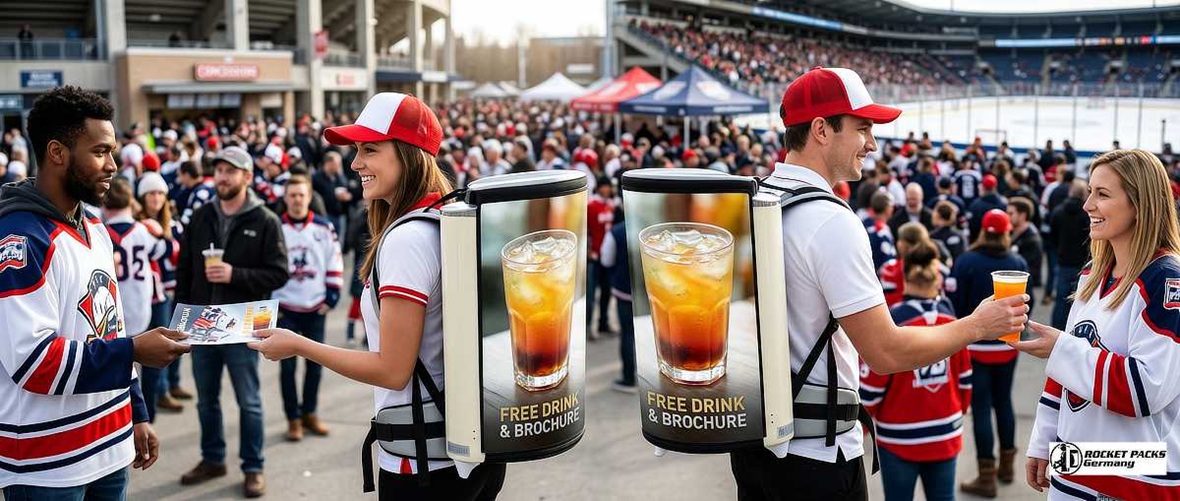
Stadium suitability still depends on aisle width, stairs, security procedures, alcohol rules, stock return and staff rotation. A general event image is not a site-specific approval.
How should the tray be prepared for mall or retail sampling?
The assortment should be lighter and the message immediately understandable. Sampling in a retail environment often requires short conversations, visible product identification and a nearby replenishment point.
The team must avoid blocking entrances, escalators and store access. Permission from the site operator remains necessary even when the equipment is fully mobile.
What daily checks should be completed before loading?
A short inspection should cover the shell, harness and selected accessories before products are added.
- Check the shell for cracks, distortion and sharp damage
- Inspect all four strap attachment points
- Confirm that buckles and padded straps adjust correctly
- Verify the selected insert or partition set
- Check the advertising pocket and artwork
- Confirm that the interior is clean and dry
- Test any payment-device mounting separately
- Record the planned starting load and replenishment point
Equipment with a damaged carrying connection should be removed from service until the issue has been assessed.
Which information is needed for an accurate vending-tray quotation?
The enquiry should identify the real product and the required operating setup.
- Package dimensions, diameter and unit weight
- Desired quantity per mobile round
- Need for the 16-hole insert or partition walls
- Cooling method and expected route duration
- Venue type, stairs and narrowest passages
- Advertising method and confirmed artwork format
- Payment or accessory requirements
- Order quantity, destination and required delivery date
These details allow the manufacturer to confirm which reference configuration, weight and capacity apply to the proposed order.